
You clicked this blog because you saw “IoT” and thought, “What in the world is that?”. If you’ve dismissed it as confusing tech jargon or just another fancy home gadget, you’re in the right place.
For your business, IoT, or “Internet of Things,” is anything but a gadget. It’s an essential shift in how you operate, and it’s simpler than you think. Let me explain to you how it really works.
What Is the Internet of Things (IoT)?
The Internet of Things means taking all the smart “things” in the world and connecting them to the internet. Your everyday objects such as your delivery van, factory machinery, or a simple meter can talk to you in real time and act on that information automatically.
Before IoT came around, collecting information used to be a slow, manual process. I’m sure you can relate to this in some way or another, so let me give you some context first. Without IoT, your office heating needs to be checked regularly, noting if it’s too high or too low, and then you adjust it, right?
With IoT, your heating sensors automatically detect room temperature changes and even senses if your staff have left for the day, adjusting your building’s heating lighting down to save energy and money – without you lifting a finger.
Essentially, IoT connectivity makes your entire business environment “smart” so it can work for you, not the other way around.
The Core Difference: Home Gadgets vs. Business Systems
Most business owners are familiar with smart devices at home or a voice assistant, or a thermostat that learns your routine. However, this is often where the concept gets confusing. Let’s put aside home gadgets for a second and focus on the differences in business.
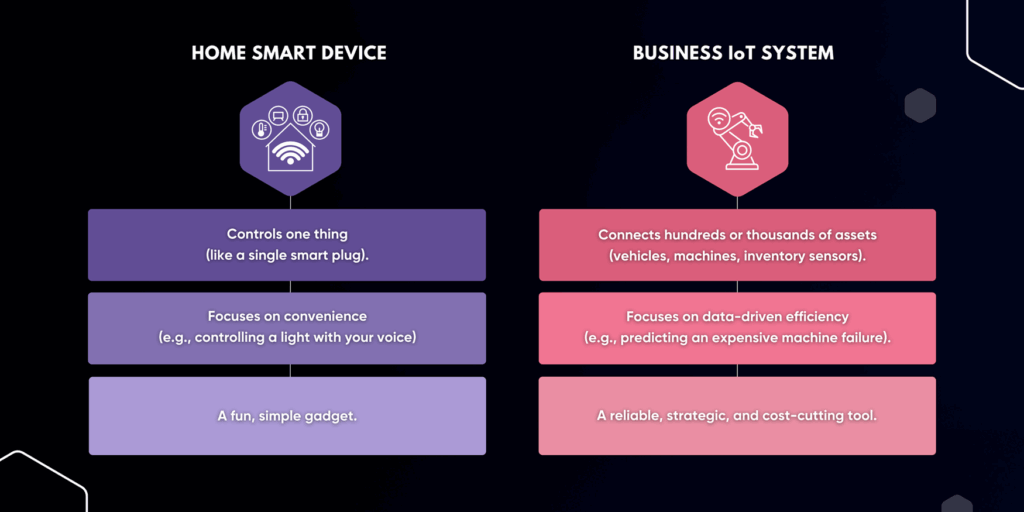
Smart home devices focus on convenience, but they are completely tied to your broadband internet connection via Wi-Fi in one location. If your Wi-Fi is down, your smart device stops working without any connectivity backup. Currently, around 39% of UK households own at least one smart device, suggesting this could rise to over 50% of households by 2027.
Devices that focus on entertainment, like smart TVs and smart speakers, are the most popular, and there is increasing demand for smart thermostats and security systems. This is because people want to save energy and feel safer in their homes.
Business IoT systems focus on making things more efficient using real-time data and are much more versatile. They are often designed around one SIM data connection, linking up many sensors and devices across different physical locations, like a chain of cafes or construction sites. You don’t need a dedicated, strong broadband connection at every single point.
Using IoT with SIM data is often cheaper because you avoid the expense of installing and maintaining a separate fixed broadband line just to connect a few essential sensors, such as temperature monitors or security alarms, in remote areas.
This provides a simple, direct, and cost-effective connection to the central system, which is a major advantage if you need to grow your business or manage ‘things’ that are spread out. The IoT market is set for big growth between 2025 and 2029 in the UK and companies – specially in manufacturing – are already using it for predictive maintenance.
How Does the “Thing” Works?
Every efficient IoT setup relies on just 3 types of “things” to get the job done:
- Sensors
Sensors are the first point of contact because they collect information and send it back as a response. For example, a pressure gauge on a pipe.
- Computers and/or Systems
These receive the information and then act on it like a software that receives a low-stock warning and places an automatic re-order.
- Things that Do Both
Any device that collects data and takes the action. For example, a utility smart meter that monitors energy use and reports consumption data.
Why It Matters for Your Business Now?
The stakes are high, especially in the UK. The simple answer boils down to a clear and urgent need for the benefits IoT provides, such as customer expectations, competitiveness, and operational resilience.
Customers expect faster,more reliable service and when a competitor can prevent a problem because their equipment is smart, your business that waits for a failure will struggle to keep up. Also, the world is going into full digital mode as the time goes on, so businesses need to be more efficient with their time and resources.
Business Backup Resilience
For business continuity, the IoT systems are built with resilience in mind. This often means incorporating backup cellular network or a low-power wide-area network (LPWAN) to ensure data keeps flowing even if the primary connection fails.
Devices often have local data storage capacity to act as a buffer, ensuring that vital information isn’t lost during temporary network outages and can be uploaded once connectivity is restored. This focus on redundancy and backup is what makes business IoT solutions truly dependable for mission-critical operations.
Stay Ahead & Stay Competitive
You don’t need to guess what’s happening in your operations anymore because IoT is the ultimate tool for operational insight. If you’d like to explore how IoT could help your business predict problems faster, cut costs, and improve your decision-making, get in touch with our IoT experts here.